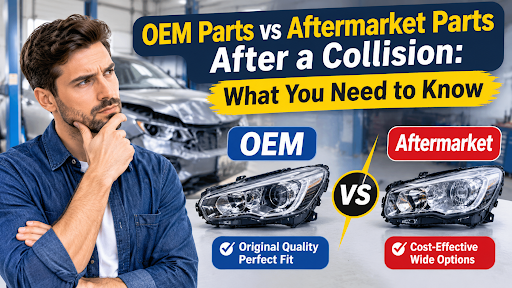

A fender bender never waits for a moment. Within days most Rockland County drivers receive a decision that nobody prepares Rockland County drivers for: OEM parts or aftermarket substitutes, on the repair estimate. The oem vs aftermarket auto parts question sounds technical. It isn’t, really. It decides how your car performs, how it still looks a year from now, and whether your warranty survives the repair shop.
Here’s what separates these two part categories, where the trade-offs actually hurt, and how local rules shape what ends up on your estimate.
Why the OEM vs Aftermarket Decision Gets Made at the Worst Possible Moment
A driver in Nanuet hits a deer on Route 304. Front bumper, headlamp housing, radiator support — all wrecked. The adjuster emails over an estimate built around a third-party fender sourced from a parts broker in New Jersey. The shop catches it fast. That CR-V has a front radar module bolted to the fender bracket, and the aftermarket piece sits roughly 4mm off at the mounting point.
Four millimeters doesn’t sound like much. It throws off adaptive cruise calibration anyway. The car still drives fine on the surface. The safety system underneath might not. This is the pressure point every collision repair shop in Rockland County deals with constantly — insurers push toward the cheaper part, and the shop has to weigh cost against function before anyone picks up a wrench.
A few things usually force the call early:
- Insurance policy wording around “like kind and quality” parts
- Vehicle age, and whether OEM supply even still exists
- Sensors, cameras, or structural reinforcement near the damage
Skip that step and you’ve inherited someone else’s shortcut. A shop willing to slow down, even by a single day, usually saves the customer a second trip back.
What Actually Separates OEM and Aftermarket Collision Parts on the Shop Floor
Set two hoods side by side on the rack. One OEM, one aftermarket. The oem parts vs aftermarket parts gap shows up fast to a trained eye. Gauge thickness varies by fractions of a millimeter. Paint adhesion differs because the e-coat process isn’t quite identical. Sometimes the mounting holes sit a hair off center, and a tech has to ream them out by hand.
None of this makes aftermarket junk, to be clear. Reputable aftermarket collision parts manufacturers certify through CAPA or NSF, and plenty pass fitment checks without a problem. The real issue is inconsistency between suppliers, not some blanket quality failure. A shop running quality control catches the bad batch before it goes on the car. One that doesn’t passes that risk straight to the customer.
What techs actually check before a non-OEM part goes on:
- Panel gap against factory spec
- Coating’s corrosion resistance
- How a structural piece behaves in a crush zone
Fit tolerance is the real divider here. A quarter panel off by two millimeters turns into a wind noise complaint eighteen months later, long after the claim closed and everyone forgot about it.
Where Aftermarket Parts Make Sense — and Where They Don’t
Context decides this. Not ideology. A 2009 pickup with 140,000 miles and a dented mirror housing? That’s a fine candidate for aftermarket — no sensors nearby, low stakes, and the lower cost keeps the repair worth doing. Put that same logic on a 2023 Tesla Model Y and it falls apart fast. The front camera bracket on that vehicle has tolerances measured in tenths of a millimeter. An aftermarket substitute risks throwing off Autopilot’s forward vision entirely.
Any collision repair shop in Rockland County working a mixed fleet — older sedans next to newer ADAS-equipped cars — ends up running two different parts strategies, sometimes on the same afternoon. Cosmetic panels with nothing electronic nearby? Aftermarket’s usually fine. Anything touching a sensor mount, an airbag zone, or crash structure? OEM becomes the safer call, sometimes the only insurable one.
Mileage and resale plans matter too. A leased car headed back to the dealer next year needs OEM to dodge lease-return penalties. A paid-off car staying in the family for another decade has more room to flex.
How Insurance Policies and State Rules Shape the Choice in Rockland County
New York requires estimates to disclose when a non-OEM part gets used. That gives drivers a paper trail most states don’t bother with. The rule exists because insurers have a financial reason to steer toward cheaper parts — aftermarket pricing often runs 20 to 40 percent below OEM on body panels. A Suffern resident disputed an aftermarket hood on her 2021 vehicle and found out the policy’s “like kind and quality” clause actually let her request OEM, in writing, as long as she covered the price gap herself.
Hardly anyone knows that clause exists. A collision repair shop in Rockland County that walks a customer through the estimate line by line of just forwarding whatever the adjuster sent surfaces options the insurer never volunteers. This is where the oem vs aftermarket auto parts conversation stops being about parts and starts being, about contract language. Reading the policy matters almost as much as reading the damage.
Shops that document every substitution — photos, measurements, notes — give customers leverage if a dispute comes up later. It protects the shop too, honestly.
How Spectrum Auto Inc. Approaches the OEM-Aftermarket Conversation
Spectrum Auto Inc. Is a collision repair shop that serves West Nyack, Montrose and Cortlandt. Spectrum Auto Inc. Treats each repair as a vehicle-by-vehicle call than a fixed policy and Spectrum Auto Inc. Prefers the vehicle-, by-vehicle call approach to a fixed policy. Shops built this way tend to run calibration checks after any part swap near a sensor housing, no matter which part category went in. Verify after install, not just before — that’s the habit separating a careful repair from a rushed one.
FAQs
- Will my insurance company force me to accept aftermarket parts?
They can propose these options. Most policies allow you to ask for OEM parts if you are ready to pay the price difference yourself. Ask your collision repair shop, in Rockland County to show you the policy language before you sign the estimate.
- How do I know if a part affects a safety sensor?
Any panel near the front grille, windshield, side mirrors, or rear bumper on a newer car probably houses a camera or radar unit. Auto body shops in Nanuet NY working on ADAS-equipped vehicles should catch this during the estimate, not after the car’s already apart.
- Do aftermarket parts void my factory warranty?
Not automatically. Federal law (Magnuson-Moss) blocks a blanket warranty denial over aftermarket parts, but a dealer can still deny one specific claim if they prove that part caused the failure.
- Is OEM always worth the extra cost?
Not always. Cosmetic panels on older cars with nothing electronic nearby rarely justify the premium. Structural or sensor-adjacent parts almost always do.