Thirty Pieces. Zero Morning Panic.
There is a specific despair known to anyone with a full wardrobe and nothing to wear: eighty pieces, most of them near-misses — the top that only works with one skirt, the trousers that need a shoe you don’t own, the beautiful thing that fits a life you don’t live. The capsule wardrobe is the discipline that ends it: a small, deliberately edited set of pieces that all work together, in colours that all cooperate, at a quality level that survives weekly wear. This capsule wardrobe guide gives you the working method rather than a fantasy list: how to find your palette (the decision everything else depends on), the 30-piece framework adapted to real lives and climates, the quality rules that matter when each piece must perform fifty times a year, and the seasonal rotation that keeps a small wardrobe feeling new. Done right, you will not own less style — you will own less hesitation, and a closet where every hanger earns its place. Special occasions sit slightly outside the capsule, which is why our companion guide on what to wear to a wedding handles the guest-dressing problem separately.
Step One: The Palette Decides Everything
Every capsule failure is a palette failure in disguise — pieces bought one “versatile” item at a time until the wardrobe contained twelve versatiles that matched nothing. So start with colour, deliberately. Choose two base neutrals that suit your skin and your life (black and grey; navy and camel; charcoal and white — the classics work because they are classics), then one or two accent colours you genuinely love wearing and that appear in your complexion’s favour, then commit: everything new must be one of these four or five colours, full stop. The test of any candidate purchase becomes instant — “does it go with my palette and at least three things I own?” — and most impulse buys die on that question, politely, in the shop, where they belong. Patterns live in the accents (a striped top, a checked scarf), because pattern-on-pattern across a small wardrobe fights; solids in the bases keep the arithmetic of mixing on your side. Thirty pieces in one palette produce more distinct outfits than eighty pieces in nine palettes — that is not minimalism rhetoric, it is combinatorics.
The 30 Pieces: A Framework, Not a Uniform
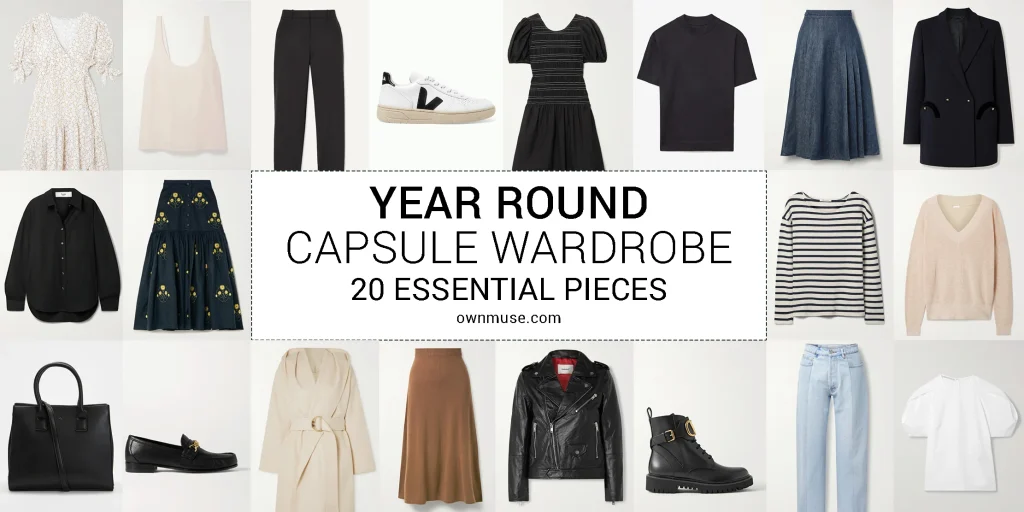
Adapt this skeleton to your climate and work; the proportions matter more than the items. Tops (8–9): a white shirt, two quality t-shirts in bases, two knitwear pieces (one fine, one chunky), a blouse or smart top, a layering tank/tee set, one accent top. Bottoms (5–6): tailored trousers in a base, jeans that fit like a promise (dark, straight or slim), a skirt or second trouser in the second neutral, casual shorts or a summer alternative by climate, one smart bottom for evenings. Dresses / one-pieces (2–3): one day dress in a base that layers, one occasion dress in an accent — the two hardest-working categories per hanger. Outer layers (4–5): a blazer or structured jacket, a proper coat in a base neutral, a casual jacket (denim/leather/trench by life), a cardigan or overshirt for the in-between. Shoes (4–5): clean trainers, an ankle boot or loafer, a smart shoe, a seasonal shoe — all in base neutrals so every outfit closes. The wildcards (3–4): the pieces with personality — the print, the colour pop, the vintage find — because a capsule without joy becomes a uniform, and uniforms get abandoned. Count honestly, edit seasonally, and let your actual life (school runs? boardrooms? both?) cast the deciding votes on every category.
Quality Rules for Pieces That Must Perform
A capsule piece is worn perhaps fifty times a year, so cost-per-wear inverts normal shopping logic: the £120 trousers worn 100 times (£1.20/wear) are cheaper than the £30 pair worn four times (£7.50/wear) — and they look it by month three. Priority order for budget: spend first on the pieces touched daily and seen closest (trousers, knitwear, coat, shoes), economise where layering hides sins (basic tees, tanks). Learn the three-second quality checks: fabric (natural fibres and tight weaves outlast; hold cloth to the light — if you can read through it, it will not survive the season), construction (seams straight and dense, patterns matched at joins, linings that lie flat), hardware (zips that glide, buttons sewn with a shank and a spare attached). Fit is the other half of quality: budget for tailoring — a £15 alteration turns a good piece into apparently bespoke, and the capsule philosophy (few pieces, perfectly fitted) makes the maths trivially in favour. Care is quality extended: wash cold and less, store knitwear folded, rest shoes between wears; a capsule wardrobe maintained is a wardrobe that keeps its promises for years.
Rotation, Editing, and the One-In-One-Out Law
A capsule is a system, maintained in three habits. Seasonal rotation: twice a year, the off-season third of the wardrobe is stored (clean, in boxes, out of sight) and the incoming season is shopped from your own storage first — the rotation refreshes your eye so effectively that “new season, new clothes” usually means “new combinations of owned clothes.” The running edit: anything unworn for a full season in rotation gets interrogated — wrong fit, wrong colour, wrong life — and exits to donation or resale without a guilt hearing; a capsule cannot carry passengers. One in, one out: every purchase retires a piece, keeping the count honest and the palette disciplined; the purchase question becomes “what does this replace, and is it better?” — a bar most shopping cannot clear, which is the point. Keep a simple list on your phone (the 30, with dates) and the whole system becomes self-auditing. What you gain is not really about clothes: it is a morning that starts with ten calm minutes and a mirror that keeps agreeing with you — and a wardrobe budget that, for the first time, visibly goes down while the dressing visibly improves. That is the entire promise, and it keeps.